
If a dog bit you or someone in your family, a personal injury lawyer is the kind of attorney who handles the claim: proving the owner or property holder is responsible, documenting your injuries and dealing with the insurance company. In New York, that proof matters more than in many states, because the state’s approach to dog bites leans on what the owner knew about the animal. At the Law Offices of Craig K. Nichols, ESQ, we handle dog bite and animal attack cases in Syracuse and Central New York on a contingency basis, so we only collect a fee if compensation is recovered for you.
This guide covers what to do in the first hours, who can be held responsible, what compensation can include and how a lawyer fits in.
TL;DR
- Get medical care first. Wash the wound, call a health-care provider and report the animal to animal control rather than trying to catch it yourself.
- New York is listed among the states that rely on common-law, “one-bite” style liability, so what the owner knew about the dog often decides the case.
- Owners are not the only possible defendants: landlords and property managers can also be responsible in some situations.
- Dog bite claims are handled by personal injury lawyers. Evidence gathered early, such as photos, medical records and witness names, makes a claim stronger.
- We represent injured people in Syracuse on a contingency fee basis: no recovery, no fee.
Table of Contents
- What to do right after a dog bite
- Why a dog bite is a personal injury claim
- Who can be held responsible in New York
- What compensation can include
- How a dog bite claim moves forward
- What a dog bite lawyer does that you cannot easily do alone
- Working with the Nichols Law Office
- Other animal attacks
- FAQ
- Sources
What to do right after a dog bite
Your health comes first, and the way you handle the first day also shapes any claim later.
Treat the wound. For a deeper bite or puncture, Johns Hopkins Medicine advises applying pressure if it is bleeding, washing with soap and running water for at least five minutes, covering it with a sterile dressing and calling a health-care provider. Do not wait to see whether it “looks bad” tomorrow. Bite wounds can hide damage to tendons, nerves and joints.
Expect two questions from the clinician. A 2023 evidence review from the American Academy of Family Physicians says tetanus vaccination and rabies post-exposure prophylaxis should be assessed for each dog or cat bite. The same review says wounds should be examined, cleaned and irrigated, and that nerve and blood-vessel function and movement of nearby joints should be documented. That documentation helps your health and later becomes part of your record of injury.
Report the animal. Johns Hopkins advises contacting animal control instead of trying to capture an unfamiliar or potentially dangerous animal. It also notes that rabies treatment may be needed when the animal cannot be found, is a high-risk species or the attack was unprovoked. A report to animal control also creates an official record that the incident happened and, often, a record about the dog.
Collect what you can while it is fresh:
- Photos of the injury on day one and as it heals, including torn clothing.
- The owner’s name, address and phone number, and where the dog lives.
- Names and numbers of anyone who saw it.
- Photos of the location: the fence, the gate, the missing leash, any warning sign.
- Every medical record, bill and prescription receipt.
- A short written note of what happened, written the same day.
Be careful with the insurance company. The owner’s homeowner’s or renter’s insurer may call you quickly and ask for a recorded statement. You can decline until you have spoken with a lawyer. Adjusters are looking for anything that suggests you provoked the dog or that the injury is minor.
Why a dog bite is a personal injury claim
A dog bite case is a personal injury case. Someone’s failure to control an animal, or to keep a property safe, injured you. The legal questions are the same ones that run through every injury claim: who was responsible, what did it cost you and what will an insurer pay.
That is why the lawyer you want is a personal injury attorney with experience in animal attack claims, not a general practitioner who sees one bite case a decade. Our personal injury practice covers dog bites and animal attacks alongside car, truck, pedestrian and other accident cases, and Craig K. Nichols has more than 30 years of experience representing injured clients.
Who can be held responsible in New York
Liability for dog bites differs from state to state. The American Bar Association explains that most states have dog-bite statutes holding owners liable. Where a state has no such statute, common-law liability may apply if the owner knew the animal was likely to cause that kind of injury, or if the owner violated leash or fencing requirements.
A 2023 state survey from the Independent Insurance Agents & Brokers of America sorts states into groups. It lists strict-liability statutes in states such as California, Connecticut, Florida, Illinois and Massachusetts, and common-law or one-bite approaches in states including New York, Texas and Virginia.
What does that mean for you in Syracuse? In plain terms:
- In a strict-liability state, the owner is generally responsible for a bite without proof that the dog had shown aggression before. Connecticut is an example: its legislature’s research office reports that state law generally makes the owner or keeper strictly liable without proof of prior viciousness or negligence.
- In a one-bite state like New York, the question usually becomes what the owner knew. Had the dog bitten or lunged at someone before? Had neighbors complained? Was the dog kept as a guard animal or chained in a way that made it aggressive? Evidence of that knowledge is the heart of the case.
This is why the evidence you gather early matters so much here. A prior complaint to animal control, a neighbor who saw the dog charge people, a sign reading “beware of dog” and a history of escaped-dog incidents can all point to what the owner knew. Our firm investigates these facts directly rather than waiting for the insurance company to hand over its version.
Also note that local rules add to state law. The American Association for Justice describes dog-bite litigation as involving a combination of city and county ordinances, state statutes, case law and common law, and says these can be used to hold not only the owner but also a landlord or premises manager responsible. Leash laws and local ordinances in Onondaga County and the City of Syracuse can therefore matter to your claim.
Possible defendants
| Who | When they may be responsible |
|---|---|
| Dog owner or keeper | Knew or should have known the dog was likely to cause this kind of harm, or broke a leash or containment rule |
| Landlord or property manager | Knew of a dangerous dog on the property and had the ability to act, depending on the facts |
| Business or property owner | The bite happened on premises they controlled and the danger was known or should have been addressed |
| Someone caring for the dog | A sitter, walker or kennel that failed to control the animal |
Which of these applies depends on the facts. Identifying every responsible party matters because each may have its own insurance policy, and more coverage can mean more available compensation. If your injury happened on someone else’s property, our premises liability work can be part of the same claim.
What compensation can include
Dog bites are often more costly than people expect. The AAFP review reports that dog bites account for an average of 337,000 emergency visits a year in the United States, and approximately 800,000 cases require medical attention, generating up to $2 billion in medical costs annually.
In an injury claim, the categories of loss generally include:
- Medical expenses: emergency care, stitches, surgery, antibiotics, vaccinations and follow-up visits.
- Future medical care: reconstructive or plastic surgery, scar treatment and therapy.
- Lost income: time missed from work while you recover, and reduced earning ability if the injury is lasting.
- Pain and suffering: the physical pain, scarring and disfigurement.
- Emotional harm: fear of dogs, sleep problems, anxiety and trauma after an attack. These effects are especially common in children.
We do not quote a number for any case in advance. Value depends on the severity of the injury, your medical records, your recovery and the insurance coverage available. What we can do is document the full scope of your losses so a settlement offer reflects them, not just the first emergency room bill.
Children and serious injuries
When a child is bitten, parents often face two problems at once: the child’s physical injury and the child’s fear afterward. Document both. Keep records of counseling, school absences and changes in behavior. A claim for a child’s injury has its own rules, so speak to a lawyer before accepting any payment from an insurer.
If an attack causes a severe head injury or permanent scarring, or a family loses someone, the stakes rise. We handle wrongful death claims as well as serious injury cases, and the family should not have to deal with insurers while grieving.
How a dog bite claim moves forward
Every case is different, but most follow the same path.
- Free consultation. You tell us what happened and bring what you have: photos, medical papers, the owner’s information. We explain whether the facts support a claim.
- Investigation. We look for the facts that prove what the owner knew or how the property was managed: animal control records, prior incidents, witnesses, ordinances and insurance coverage.
- Treatment and documentation. You focus on getting better. We track medical records and costs so the claim reflects your full recovery, and we avoid settling before the extent of the injury is clear.
- Demand and negotiation. We present the claim to the insurer with supporting evidence and negotiate on your behalf.
- Filing suit if needed. If a fair settlement is not offered, the case can go to court.
One point cannot wait: New York sets a deadline, called a statute of limitations, for filing an injury lawsuit. Waiting too long can end your right to compensation no matter how strong the facts are. Speak with a lawyer early, especially if a child was bitten or if the injury involved a government property or employee, where shorter notice rules can apply.
What a dog bite lawyer does that you cannot easily do alone
You can call the insurance company yourself. The difficulty is that the adjuster works for the insurer, and the claim is judged on evidence you may not know to gather. A lawyer takes on the parts of the case that tend to go wrong:
- Proving knowledge. In a one-bite state, you need to show the owner’s awareness of the danger. That means finding prior incidents and witnesses, which takes time and knowledge of where to look.
- Finding every insurance policy. Homeowner’s, renter’s and landlord’s policies, and business coverage, may each be in play.
- Valuing the claim. Settlement amounts depend on future care and lasting effects, which are easy to underestimate in the first weeks.
- Handling the insurer. Recorded statements, medical authorizations and early low offers are where injured people most often damage their own claims.
The firm’s own approach is built around personal attention: direct communication with you, thorough investigation and detailed work on each case. We also offer multilingual support and cultural competency for immigrant clients, who sometimes hesitate to pursue a claim because of language or status worries. If that is you, we can talk through your situation in a consultation.
Working with the Nichols Law Office
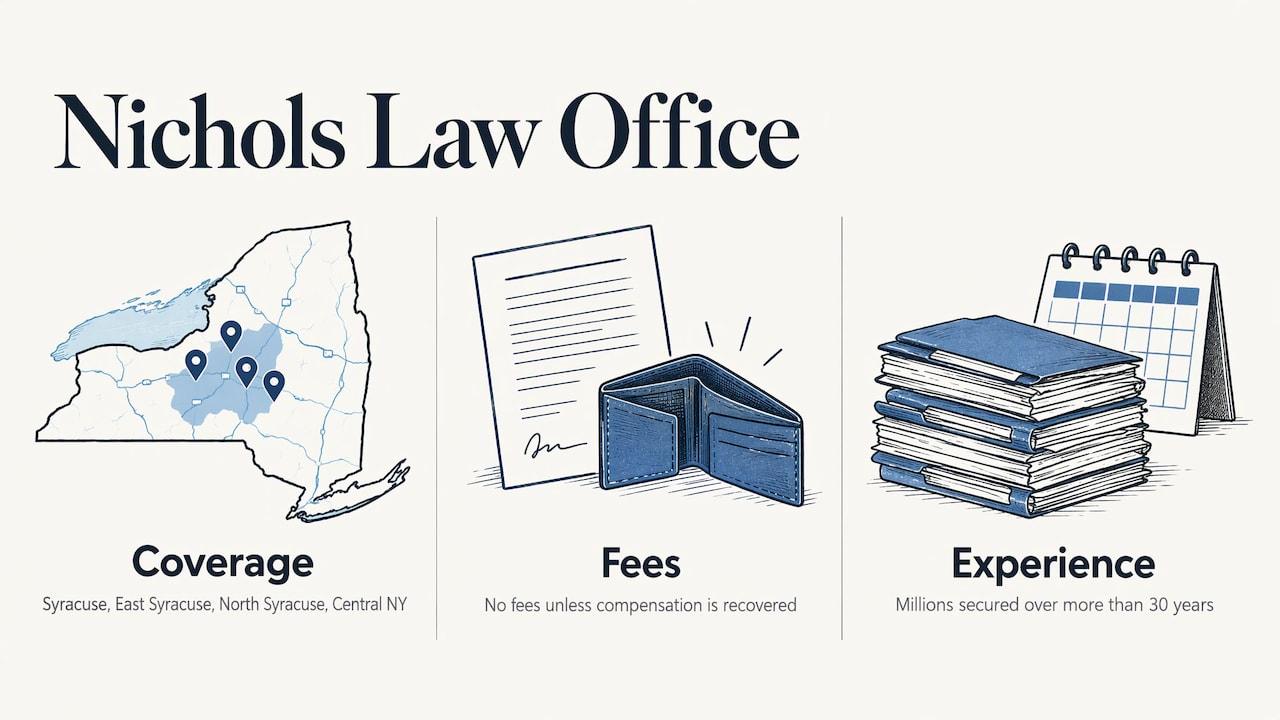
We represent people injured by dog bites and animal attacks across Syracuse, East Syracuse, North Syracuse and Central New York. Consultations are offered on a contingency fee basis, which means you do not pay fees unless we recover compensation for you. Our firm has secured millions for clients over more than 30 years in practice.
If you or your child was bitten, you can start with our dog bite and animal attack page or reach us through the Nichols Law Office website.
For a broader look at how injury claims work locally, our guide to understanding personal injury claims in Syracuse walks through the process, and the step-by-step guide on what to do after an accident applies to bites as well.
Other animal attacks
Not every attack involves a dog. Cats, horses, livestock and other animals can cause serious injuries, and the same questions apply: who owned or controlled the animal, what did they know and what do your medical records show. The medical steps above apply to any bite, and rabies risk depends on the species and the circumstances, so tell your provider what animal it was and whether it can be found. We handle animal attack claims of all kinds, and the facts will decide which legal theory fits.
FAQ
What kind of lawyer handles dog bite cases?
Dog bite cases are handled by personal injury lawyers. These claims involve injury law, liability disputes and insurance negotiations. Look for an attorney who regularly represents injured people and who works on contingency, so the legal fee depends on recovering compensation for you.
How much does a dog bite lawyer cost?
At our firm, consultations are offered on a contingency fee basis, and we collect a fee only if compensation is recovered for you. We do not publish a price, and the terms of your agreement are explained before you sign anything.
Does New York hold dog owners automatically responsible for a bite?
New York is listed among the states using common-law or one-bite approaches, according to the 2023 insurance industry state survey. In practice, what the owner knew about the dog’s behavior is often central. A lawyer can look at the facts of your attack and tell you how the rule applies.
Can I make a claim if the dog bit my child or I was bitten on someone else’s property?
Yes, both can support a claim. A parent can pursue a claim for a child’s injury, and a landlord or property manager may be responsible in some situations. Speak with an attorney soon, because deadlines and notice rules vary with who is involved.
Should I see a doctor even if the bite is minor?
Yes. Johns Hopkins advises calling a health-care provider after a deeper bite or puncture, and the AAFP says tetanus and rabies risk should be assessed for each bite. Medical records also document the injury for your claim.
Sources
- Animal Bites and Rabies, Johns Hopkins Medicine
- Dog and Cat Bites: Rapid Evidence Review, American Academy of Family Physicians (2023)
- The Law and Your Home, American Bar Association
- Dog Owner Liability Rules by State, Independent Insurance Agents & Brokers of America (2023)
- Dog Bite Liability and Quarantine Process, Connecticut Office of Legislative Research (2026)
- Dog Bite Injury, American Association for Justice