
If you or someone in your family was hurt on or by a bus, hire a bus accident lawyer before you speak with any insurer or transit agency. Bus claims often involve a public agency or a commercial carrier, and both have rules and deadlines that ordinary car claims do not. The Law Offices of Craig K. Nichols, ESQ, bring more than 30 years of personal injury experience to injured people and families in Syracuse and Central New York, and the firm is paid only if compensation is recovered for you.
This guide explains what a bus accident lawyer does, who can be held responsible, which deadlines can end a claim, what to do in the first days and how fees work.
TL;DR
- A bus crash usually has more than one responsible party: the driver, the company that employs the driver, a public transit agency, a maintenance contractor or another motorist.
- If the bus belongs to a public agency, a written notice of claim may be due within 90 days in New York. Waiting can end the claim before it starts.
- Medical records, the bus company’s driver logs and any video decide most claims, and some of that evidence is not kept forever.
- Personal injury lawyers commonly work on contingency: no fee unless money is recovered. Our firm works this way.
- Families who lost someone in a bus crash have separate rights and a separate clock under wrongful death law.
Table of Contents
- What a bus accident lawyer actually does
- Who can be responsible for a bus accident
- The deadline that surprises most people
- What to do after a bus accident
- Evidence that proves a bus claim
- What compensation may cover
- How bus accident lawyers get paid
- How to choose a bus accident attorney
- Talk to our team about your bus accident
- FAQ
- Sources
What a bus accident lawyer actually does
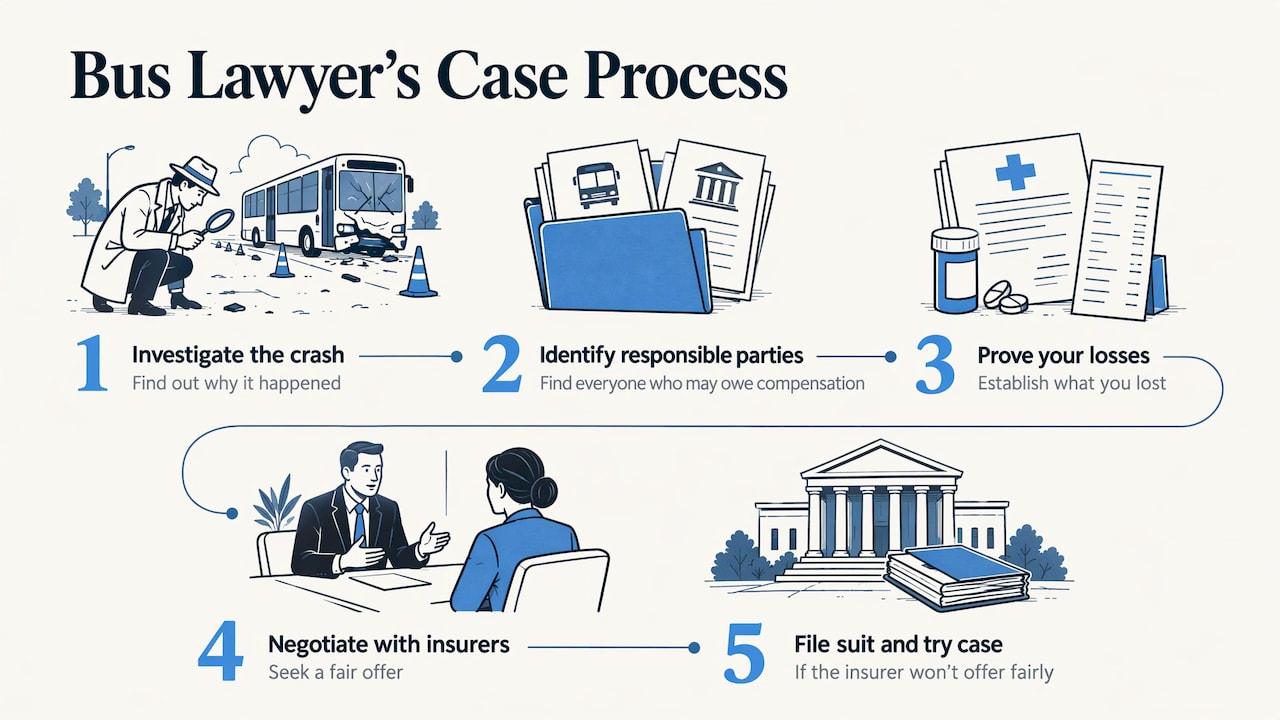
A bus accident lawyer investigates why the crash happened, identifies every party who may owe you compensation, proves your losses and negotiates with the insurers who pay. If the insurer will not make a fair offer, the lawyer files suit and takes the case to trial.
That is different from a typical fender-bender claim, for three reasons.
The defendant is rarely one person. A city bus driver works for a transit authority. A charter or tour bus belongs to a company that may also lease it, hire a separate maintenance shop and insure it through a commercial policy. A school bus may be run by a district or by a contractor. Each of these can point at the others.
The insurers are professionals. Commercial carriers and public agencies have claims staff and defense counsel whose job is to limit what they pay. A recorded statement given casually in the first week can be used against you months later.
The injuries are often serious. Buses are heavy and passengers usually are not belted the way car occupants are. People are thrown into seats, poles and aisles, or are struck while crossing the street. Head injuries, spinal injuries, fractures and chronic pain are common reasons people seek counsel, and the firm handles head and brain injuries and spinal cord injuries as part of its personal injury practice.
You may need a lawyer if you were a passenger, a pedestrian or cyclist hit by a bus, the driver of another vehicle, or a family member of someone killed. If you were only shaken up and have no medical bills or missed work, a call may still be worthwhile, because some injuries show up days later.
Who can be responsible for a bus accident
Fault is the first question, and the answer decides whom you can claim against and how much insurance sits behind the claim.
The driver
Bus drivers can be distracted, speeding, impaired or simply tired. Federal rules limit how long a passenger-carrying commercial driver can work. Under the Federal Motor Carrier Safety Administration’s hours-of-service rules for passenger carriers, a driver may not drive more than 10 hours after 8 consecutive hours off duty, may not drive after being on duty 15 hours following 8 hours off, and is capped at 60 hours on duty in 7 consecutive days (70 hours in 8 days for carriers that operate every day). A driver who exceeded those limits, or a company that scheduled routes that made them hard to follow, may be responsible for a crash caused by fatigue.
The bus company or agency
The employer is generally answerable for what its driver does on the job. It can also be directly at fault for how it hired, trained and supervised drivers, how it kept the vehicle maintained and how it set schedules. Driver logs, maintenance records and hiring files are where that story is found.
Other parties
Depending on the facts, responsibility can reach:
- another motorist who cut off or struck the bus;
- a mechanic or parts maker whose work or product failed, such as brakes or tires;
- a government body responsible for a dangerous road or intersection;
- a property owner, if you were hurt at a stop, station or lot (see our page on premises liability).
If another driver caused the crash, the claim works much like a car accident claim. If a commercial vehicle such as a motor coach was involved, the investigation overlaps with what we do on truck accidents, including carrier records and driver logs. If you were riding a ride-hailing vehicle instead of a bus, see rideshare accidents.
The deadline that surprises most people
The most important difference in bus cases is that the vehicle may belong to the government. When it does, you often cannot simply file a lawsuit. You must first give the agency formal written notice, and the window is far shorter than the usual time to sue.
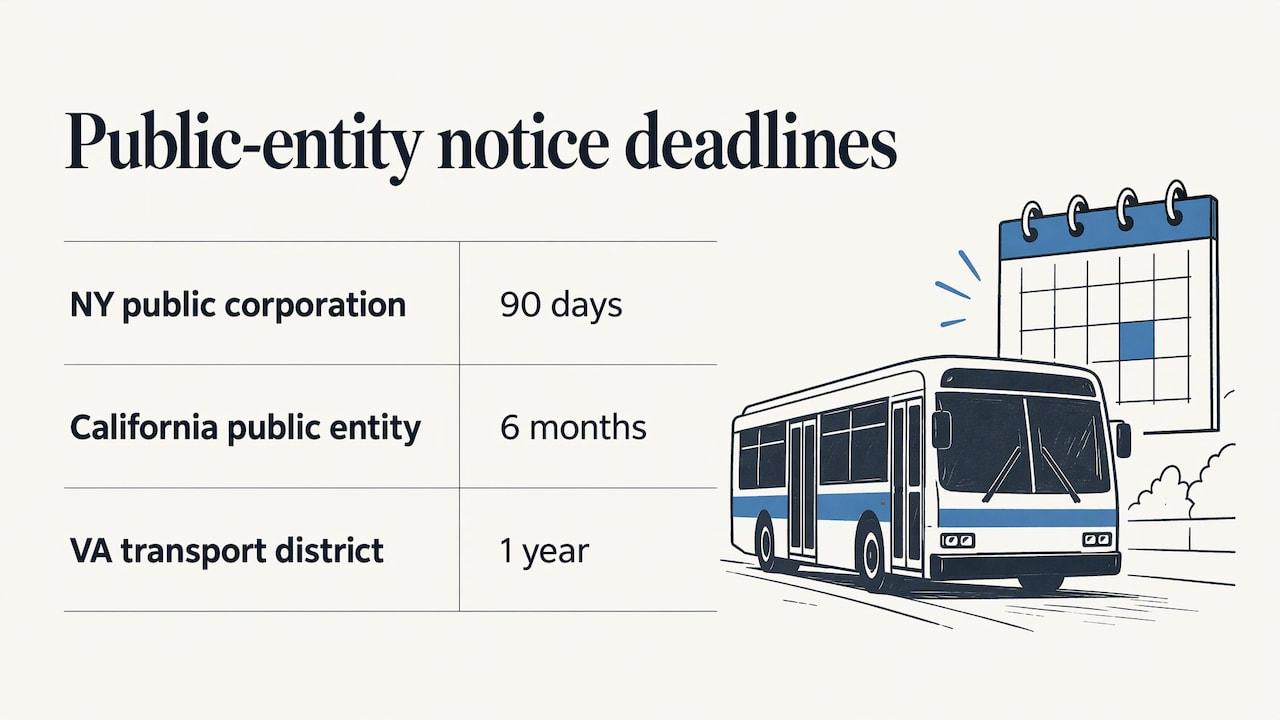
In New York, the General Municipal Law requires a notice of claim in tort cases against a public corporation within ninety days after the claim arises. In wrongful death cases, that ninety days runs from the appointment of a representative of the person’s estate. The notice has to contain specific information and be served correctly, which is why it should not be a letter you write from a hospital bed.
Other states have their own versions. Virginia, for example, bars claims against transportation districts unless notice is filed within one year of when the cause of action accrues. In California, a court decision about a transit district recounted a six-month deadline for filing a claim with a public entity. The numbers differ by state and by defendant, and they change when legislatures amend them, so the safe rule is to treat the shortest possible deadline as the real one until a lawyer tells you otherwise.
If the bus was privately owned, ordinary statutes of limitations apply instead, and those are longer, but the evidence problems below make early action just as important. Because the right deadline depends on who owned and operated the bus, find out that fact early. A lawyer can often determine it from the crash report and the vehicle’s markings.
What to do after a bus accident
The steps below protect your health first and your claim second. Our page on what to do as an injured passenger goes into more detail.
- Get medical care. Call 911 if anyone is hurt. Accept the ambulance or go to the emergency room the same day, even if you feel “okay.” Adrenaline hides pain, and a prompt record ties your injuries to the crash.
- Report the accident. Make sure police respond and a report is created. Ask the driver or the agency for the bus number, route and company name.
- Collect what you can. If you can, photograph the bus, its number, the road, your injuries and any visible damage. Get names and phone numbers of other passengers and witnesses. Passengers scatter quickly, and they are often your best witnesses.
- Do not give a recorded statement. The bus company’s insurer may call you quickly and sound friendly. You are not required to give a recorded statement. Share your contact details and say your attorney will be in touch.
- Keep every record. Save medical bills, discharge papers, prescriptions, pay stubs showing lost wages and any receipts for travel to treatment. Keep a short daily note of pain, sleep and activities you cannot do.
- Follow your treatment plan. Gaps in treatment give insurers an argument that you were not really hurt.
- Call a bus accident lawyer quickly. A lawyer can send preservation letters so the carrier keeps driver logs, maintenance files, dashcam and onboard camera footage, and can calendar the notice deadline while you recover.
- Stay off social media. Photos of a hike or a party can be quoted back to you out of context.
Nothing here replaces medical advice. For symptoms such as a headache that will not go away, confusion, numbness, or back or neck pain after impact, see a doctor right away and say you were in a bus crash.
Evidence that proves a bus claim
Bus cases are won on records that you will not be able to get on your own, which is one reason people hire counsel early.
| Evidence | What it shows | Who holds it |
|---|---|---|
| Driver logs and schedules | Fatigue, hours-of-service violations | Bus company or agency |
| Maintenance and inspection records | Brake, tire or steering problems | Operator, repair contractor |
| Onboard and exterior video | How the crash happened, what the driver did | Operator, sometimes nearby businesses |
| Driver hiring, training and discipline files | Whether the employer knew of problems | Employer |
| Event data and GPS | Speed, braking, route | Vehicle systems, operator |
| Police report and witness accounts | Initial fault findings, independent versions | Police, passengers |
| Medical records and bills | The injuries and their cost | Your providers |
Video is often overwritten on a schedule. A prompt written request to preserve it is far more likely to succeed than one sent months later.
What compensation may cover
Compensation in an injury case is meant to cover what the crash cost you. Depending on your situation, that can include:
- medical bills, past and expected future treatment, therapy and equipment;
- lost wages and reduced ability to earn in the future;
- pain and suffering and loss of enjoyment of life;
- for families after a death, the losses recognized under wrongful death law, such as funeral costs and loss of support.
No honest lawyer can promise a figure at the start. The value depends on the severity and permanence of your injuries, the clarity of fault and the insurance available. Having every defendant identified early matters, because it can open up more coverage than the bus driver’s policy alone.
If you lost a loved one, the claim belongs to the estate and the family in ways the law defines, and it follows its own timeline. Our wrongful death page explains how we approach those cases with families.
How bus accident lawyers get paid
Most people hurt in a crash cannot pay an hourly rate while they are out of work and facing medical bills. That is why injury lawyers commonly use contingency fees: the fee is a percentage of the recovery, and if there is no recovery there is no fee. The Law Offices of Craig K. Nichols, ESQ, offer consultations and represent clients on a contingency fee basis, and the firm only collects fees if compensation is recovered.
Before you sign any agreement with any lawyer, ask for it in writing and ask three questions:
- What percentage applies, and does it change if the case goes to trial?
- Are case costs (records, experts, filing fees) paid from the recovery, and how are they treated alongside the fee?
- What will I be told about settlement offers, and who decides whether to accept one?
The answers should be plain enough to read back to a family member.
How to choose a bus accident attorney
A flashy billboard tells you little. These things matter more.
Experience with the kind of defendant you face. Cases against transit agencies and commercial carriers need someone who knows the notice rules, the insurers and the records to demand. Our firm’s focus is personal injury and wrongful death, with more than 30 years of experience behind it.
Direct communication. Ask who will return your calls and how often you will get updates. Our firm prioritizes direct communication with clients and attention to detail, so your questions get answered by the people handling your case.
Thorough investigation. A good lawyer should be able to explain, in plain language, what they will collect and from whom in the first month.
Language and cultural fit. If English is not your first language, or you are worried that your immigration status affects your rights, find someone who can speak with you comfortably. We offer multilingual support and consultative help for immigrants and non-citizens navigating injury claims, so you can describe what happened in your own words.
Local knowledge. For crashes in Syracuse, East Syracuse, North Syracuse and the rest of Central New York, a local attorney knows the courts, the roads and the agencies involved. Our guide to personal injury claims in Syracuse explains how claims move through the local process.
Talk to our team about your bus accident
If you were hurt in a bus crash in Syracuse or anywhere in Central New York, or you lost a family member, the Law Offices of Craig K. Nichols, ESQ, can review what happened, work out who may be responsible and make sure the deadlines that apply to you are met. Our personal injury practice covers passengers, pedestrians and drivers hurt in crashes involving buses, trucks, cars and motorcycles, and every case is treated as personal.
Visit our home page to request a consultation. You pay nothing unless we recover compensation for you.
FAQ
How soon should I contact a bus accident lawyer?
As soon as you are medically stable, and ideally within days. If a public agency owns the bus, New York can require a notice of claim within 90 days, and video and driver records can be lost if no one asks the operator to preserve them.
Can I claim if I was a pedestrian or in another car, not on the bus?
Yes. Passengers, pedestrians, cyclists and other drivers hit by a bus can all pursue claims if someone’s negligence caused the crash. Our pages on pedestrian accidents and car accidents explain how those cases work.
What does it cost to hire a bus accident attorney?
Our firm works on a contingency fee basis. You pay no fee unless compensation is recovered for you. Ask for the fee agreement in writing, including how case costs are handled, before you sign.
What if my family member died in a bus crash?
The law gives families a separate wrongful death claim with its own timing. In New York, the notice period for a public agency can start when an estate representative is appointed, so speak with a lawyer soon after the loss, whenever you feel able.
Does immigration status stop me from making a claim?
No one should assume it does. Our firm offers multilingual support and consultative help for immigrants and non-citizens, so you can explain your situation confidentially and learn your options.
Sources
- Hours of Service for Motor Carriers of Passengers, FMCSA
- New York General Municipal Law § 50-e, Notice of claim
- Virginia Code § 8.01-195.7, Statute of limitations
- Gilberd v. AC Transit (1995), California Court of Appeal