
A contingency fee lawyer is paid only if your case recovers money. The lawyer takes an agreed percentage of the settlement or award, usually somewhere around one-third, and you pay no hourly bill and no fee if there is no recovery. At the Law Offices of Craig K. Nichols, ESQ in Syracuse, consultations are offered on a contingency basis and the firm collects a fee only if compensation is recovered for you. The percentage is only half the story, though. How case costs are handled changes what you take home, and the written agreement is where you find out.
Key Takeaways
- Under a contingency fee, the lawyer’s fee comes out of the money recovered. If the case is lost, you owe no attorney fee.
- The common range is one-third to 40% of the recovery. In New York, court rules set maximum percentages for personal injury cases.
- Case expenses (filing fees, records, experts) are separate from the fee. Ask whether the percentage is calculated before or after those costs come out, because it can change your net by hundreds or thousands of dollars.
- New York requires a written letter of engagement that explains the fee. Read it before you sign, and keep a copy.
- A good first consultation is about facts, deadlines and the fee agreement, not about pressure to sign.
Table of Contents
- How a contingency fee works
- What percentage do injury lawyers charge?
- Fee versus costs: the part most people miss
- What the written agreement should say
- What a free consultation covers
- Who contingency representation is built for
- How the Nichols firm handles it
- FAQ
- Sources
How a contingency fee works
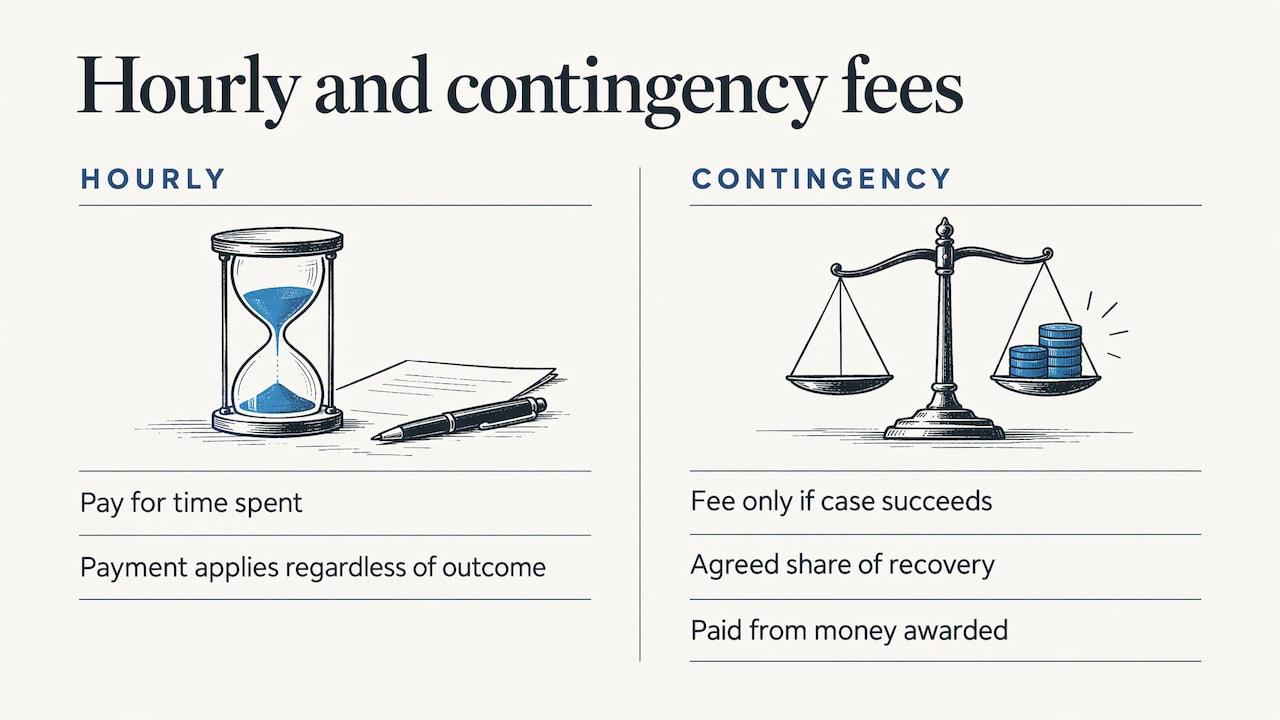
Most people hire a lawyer by the hour. You pay for time spent, whether or not the outcome is good. A contingency arrangement flips that. According to the American Bar Association, a contingent fee is payable only if the case is successful. The lawyer accepts a fixed percentage of the amount recovered, often one-third to 40%. If you win, the fee comes out of the money awarded. If you lose, neither you nor the lawyer receives money for the work.
The ABA also explains why this suits injury cases. Personal injury claims often require considerable and complicated investigation, so a percentage of the recovery can cost less than hourly billing. It also lets you put off paying for litigation until there is a settlement or award.
The State Bar of Wisconsin makes the protection point plainly: the client never receives a fee bill, and the fee can never exceed the agreed percentage of whatever is recovered. The bar says that matters most after an accident, when medical bills and lost wages are already piling up.
In short, the lawyer carries the early financial risk. That is why a lawyer reviewing your case also has a reason to judge honestly whether it can be won.
What percentage do injury lawyers charge?
Nationally, one-third to 40% is the usual range per the ABA. Many agreements use one-third for a case that settles and a higher figure if it goes to trial or appeal, because trial means far more work. The ABA says a fee must be reasonable from an objective point of view, considering things like the time and difficulty involved, local rates, the results and the lawyer’s experience.
The answer to “is 40% too high?” depends on the state and the stage of the case. Some states set a ceiling. Michigan, for example, caps contingent fees in personal injury and wrongful death claims at one-third of the net amount recovered under Court Rule 8.121. Other states rely on a general reasonableness standard.
What New York requires
If you were hurt in Syracuse or elsewhere in Central New York, New York rules apply. The state’s four Appellate Division courts have identical rules setting the maximum permitted percentages in personal injury and wrongful death cases, absent a court order. In comments filed with the court system, the New York State Bar Association described one-third as the maximum under those rules for recoveries of the size it used in its example, and noted that the rules apply the percentage to the net recovery after the expenses of the successful suit are deducted.
New York also requires a written agreement. Under 22 NYCRR 1215.1, a lawyer who takes on a client and charges a fee must give the client a written letter of engagement before starting, or within a reasonable time after. If the fee or scope of services changes significantly, an updated letter must follow.
Medical malpractice claims follow a different, sliding-scale statute, so the figures in this guide are for ordinary injury cases such as crashes, falls and dog bites.
Fee versus costs: the part most people miss
The fee pays the lawyer. Costs pay for building the case. Typical costs, as listed in the Massachusetts court guidance, include filing fees, service of process, deposition costs, expert witness fees, photocopying and medical records.
What happens to them if you lose? The State Bar of California says that under a contingency fee you owe no fee on a lost case, but you may still have to pay some or all court costs and expenses, win or lose, and you should get a cost estimate at the start. Indiana’s professional conduct rule requires the agreement to notify the client of any expenses owed even if the client does not prevail. Arrangements differ from firm to firm, so this is the line in the agreement to read twice.
Before or after: a worked example
The ABA gives a clean example. On a $12,000 recovery with $2,100 in expenses and a one-third fee:
- If the fee is taken first, you net $5,900.
- If expenses come out first and the fee is figured on what remains, you net $6,600.
That is a $700 difference from one clause. The ABA says the lawyer should explain in writing how costs are deducted. The Maryland People’s Law Library makes the same point: calculating the fee after expenses are deducted increases the amount the client receives.
Here is the same logic on a larger, purely illustrative number. Say a case settles for $100,000, case expenses are $5,000, and the fee is one-third.
| Method | Attorney fee | Expenses | You receive |
|---|---|---|---|
| Fee on the gross, then expenses | $33,333 | $5,000 | $61,667 |
| Expenses first, fee on the net | $31,667 | $5,000 | $63,333 |
The gap is about $1,667. These figures are arithmetic on made-up inputs, not a prediction for any case. Your actual amount can also be reduced by other items, such as repayment owed for medical care that an insurer or program paid. Ask your lawyer to list every deduction they expect before you sign.
What the written agreement should say
States differ on the exact wording, but the same items keep appearing. The State Bar of California says its law requires a contingent fee agreement to state the percentage, how costs affect the fee and your recovery, and whether you might owe for related matters outside the agreement. Indiana’s rule asks for the percentages at settlement, trial or appeal, and the expenses to be deducted. It also requires a written closing statement of the outcome and how any payout was figured.
Use this as a checklist for any injury lawyer, including in New York:
- The percentage at each stage. Is it one number, or does it rise if a lawsuit is filed or the case goes to trial?
- Costs before or after the fee. Get the method in writing.
- Who advances costs, and what if there is no recovery? Ask directly whether you would owe anything.
- What the agreement covers. A car crash claim is not automatically a claim for related matters like a separate insurance dispute.
- How you are told about offers. You should know about settlement offers and have the final say on accepting them.
- The final statement. Ask for a written breakdown showing the settlement, the fee, each cost and your net payment.
What a free consultation covers
A free consultation is the first meeting where the lawyer hears what happened, tells you whether you appear to have a claim, and explains how the fee would work. Some lawyers do charge for a first meeting, according to the Massachusetts guidance, so confirm up front that yours is free. At the Nichols firm, consultations are offered on a contingency basis.
Bring what you have, but do not wait to gather everything:
- The police or incident report, if there is one, and the other party’s insurance details
- Photos of the scene, vehicles, hazards or injuries
- Medical records, discharge papers and bills so far
- Pay stubs or a note from your employer about missed work
- Any letters or calls from an insurance company, and the name of the adjuster
Questions worth asking:
- Who will actually handle my case day to day, and how will you keep me updated?
- What is your fee at each stage, and are costs deducted before or after it?
- What costs do you expect in a case like mine?
- What deadlines apply to my claim?
- Do you have experience with this type of accident?
Time limits matter. New York sets deadlines for filing injury and wrongful death claims, and some claims against government bodies require early notice. A prompt consultation is how you find out which deadline applies to you.
Who contingency representation is built for
Contingency pricing exists to widen access to the courts for people who cannot front legal fees. It fits injured people with medical bills and lost income, families after a wrongful death, and anyone facing an insurer with a team of adjusters and lawyers. It also fits non-citizens who worry that legal help is out of reach. The Nichols firm offers multilingual support and cultural competency for immigrant clients, so language need not be a barrier to understanding a fee agreement.
How the Nichols firm handles it
The Law Offices of Craig K. Nichols, ESQ has more than 30 years of experience representing people injured in auto accidents, truck crashes and wrongful death cases across Syracuse and Central New York. The firm collects a fee only if compensation is recovered, and its approach centers on personal attention, thorough investigation and direct communication with each client.
If your injury came from a specific kind of accident, these pages explain what the firm handles:
To talk through your own situation and the fee terms that would apply, start with a consultation.

For a wider view of how a claim moves from accident to payment, the firm’s guide to personal injury claims in Syracuse walks through the process, and its page on what to do after an accident covers the first steps.
FAQ
What do most lawyers charge on contingency?
Most injury lawyers charge between one-third and 40% of the recovery, according to the American Bar Association. In New York, court rules cap the percentage in personal injury and wrongful death cases, and one-third is the usual figure. The agreement should state the exact percentage.
How much of a $100,000 settlement would I receive?
With a one-third fee and $5,000 in costs, you would receive roughly $61,667 to $63,333, depending on whether the fee is figured before or after costs. Other deductions, such as medical repayments, can lower it. Ask for a written estimate of all deductions.
Do I owe anything if we lose?
You owe no attorney fee on a lost case. Costs are a separate matter: the State Bar of California notes that clients may still owe some or all court costs and expenses. Get the answer for your own agreement in writing before you sign.
Is it better to hire a lawyer on contingency?
For most injury claims, yes. You pay nothing up front, the fee is tied to the result, and the lawyer shares the risk. The ABA notes that a percentage fee can also cost less than hourly billing in complex injury cases.
Does a free consultation obligate me to hire the lawyer?
No. A consultation is for both sides to assess the case and the fee terms. You decide whether to sign the letter of engagement afterward, and you can take time to read it.
Sources
- American Bar Association: How Do I Settle on a Fee with a Lawyer?
- State Bar of Wisconsin via WNA: No money down, how contingency fees work
- Michigan Court Rule 8.121: Contingent Fees
- New York State Bar Association comments on contingent fee computation (nycourts.gov)
- 22 NYCRR 1215.1: Written letter of engagement
- Mass.gov: If You Decide to Hire a Lawyer
- State Bar of California: What to Expect Regarding Fees and Billing
- State Bar of California: Sample Written Fee Agreement Instructions (2025)
- Indiana Rule of Professional Conduct 1.5
- Maryland People’s Law Library: Attorneys Fees in Personal Injury Cases
Recommended
- Personal Injury Lawyer in Syracuse NY: Your 2026 Guide to Maximum Compensation
- Personal Injury Lawyer in Syracuse, NY: Get the Compensation You Deserve After an Accident
- Personal Injury Claims in Syracuse NY: Your Complete 2026 Guide to Getting the Compensation You Deserve
- Personal Injury Lawyer in Syracuse, NY: Protecting Your Rights After an Accident