
If a crash, fall or other accident left you or someone you love with a brain injury caused by another party’s negligence, you need a lawyer who will build the case around the long-term picture, not just the first hospital bills. At the Law Offices of Craig K. Nichols, ESQ, we bring more than 30 years of personal injury experience to families in Syracuse and Central New York, and we work on a contingency basis: we only collect a fee if compensation is recovered for you.
This guide explains how a traumatic brain injury (TBI) claim works in New York, which deadlines matter, what compensation can cover, and what a lawyer should be doing for you from the first week.
Key Takeaways
- New York generally gives you three years from the date of injury to sue for personal injury, but claims against a government body and wrongful death claims run on different, shorter clocks.
- A brain injury claim is only as strong as its medical record. Symptoms that appear late, such as memory trouble or mood changes, need to be documented early.
- Compensation can cover medical care, lost income, and pain and suffering, and the value depends on proof of how the injury changes your future, not only on the diagnosis label.
- Even a partly shared fault does not end a New York claim: your compensation is reduced by your share, not eliminated.
- We handle brain injury cases on a contingency fee basis, so you pay no legal fee unless we recover money for you.
Table of Contents
- What counts as a traumatic brain injury
- Signs that should be documented right away
- The deadlines that decide whether you can file
- What a brain injury claim can recover
- Car accidents and the New York “serious injury” rule
- When you were partly at fault
- How a brain injury case is built
- Workplace, construction and other special cases
- How to choose a brain injury lawyer
- Working with us on a contingency fee basis
- FAQ
- Sources
What counts as a traumatic brain injury
The CDC describes a traumatic brain injury as an injury to the brain caused by a bump, blow or jolt to the head, or by an object that penetrates the skull. Severity is grouped from mild (often called a concussion) to moderate and severe.
For a legal claim, the word “mild” can mislead. A concussion can still change how a person works, sleeps, drives, remembers and relates to family. What matters in a claim is not the label alone but what the injury has done to your daily life and what your doctors expect next.
Common causes we see in Central New York cases include:
- Car, truck, motorcycle and rideshare collisions, where the head strikes the window, wheel or pavement, or the brain is jolted by sudden impact
- Pedestrian and bicycle strikes
- Slip and fall accidents on icy walkways, stairs or poorly maintained property
- Falls and struck-by accidents at construction sites and workplaces
- Dog attacks and other assaults by animals
Our page on head and brain injuries covers the types of injury we handle in more detail.
Signs that should be documented right away
Brain injuries are easy to miss in the emergency room, especially when there is no visible wound and no loss of consciousness. Family members often notice changes before the injured person does. Write down, with dates:
- Headaches that do not fade, dizziness or balance problems
- Trouble with memory, concentration or finding words
- Sensitivity to light or noise, and sleep changes
- Irritability, anxiety, depression or personality changes
- Difficulty returning to the work or routine you managed before
See a doctor promptly and tell every provider about each symptom, including the ones that seem minor. Gaps in treatment and vague records are what an insurance company looks for when it argues the injury is not serious or came from something else. Seeking medical care is first about your health, and it also creates the record the claim depends on.
The deadlines that decide whether you can file
Time limits in New York are strict, and missing one can end a claim no matter how strong the facts are.
| Type of claim | General deadline | Source |
|---|---|---|
| Personal injury (negligence) | 3 years from the injury | CPLR 214 |
| Wrongful death | 2 years from the date of death | EPTL 5-4.1 |
| Claim against a municipality (city, county, town) | Notice of claim within 90 days of the claim arising | General Municipal Law 50-e |
These are the general rules. Exceptions exist, and the right deadline depends on who is responsible and what happened, so treat them as the outer limit and not a target. If a city bus, a county road crew, or a public building is involved, the 90-day notice period makes a prompt call especially important. If your loved one died as a result of a brain injury, our wrongful death team can explain who may bring the claim and what it can recover.
What a brain injury claim can recover
Compensation in a New York injury case is meant to cover the real losses the injury caused. In a brain injury case that usually includes:
- Medical expenses: emergency care, imaging, hospital stays, surgery, medication, therapy and rehabilitation, and the projected cost of future care
- Lost income: wages missed during recovery and, where the injury limits your ability to work, the reduction in future earning capacity
- Pain and suffering: the physical pain and the loss of enjoyment of life that come with the injury
- Care at home: the cost of assistance if you or a family member need help with daily tasks
No honest lawyer can promise a settlement figure at the start, and you should be wary of anyone who does. Value is driven by the evidence: how severe the injury is, how long it will last, how clear the other party’s fault is, and how much insurance coverage is available.
Why future costs matter most
The biggest mistake in brain injury cases is settling when the full picture is not yet known. A person who seems to be recovering at three months may still have cognitive or emotional effects that limit work at two years. Once you sign a settlement release, you generally cannot go back for more. A strong case waits for treating doctors to describe the likely course of recovery, and builds the claim around that prognosis.
Car accidents and the New York “serious injury” rule
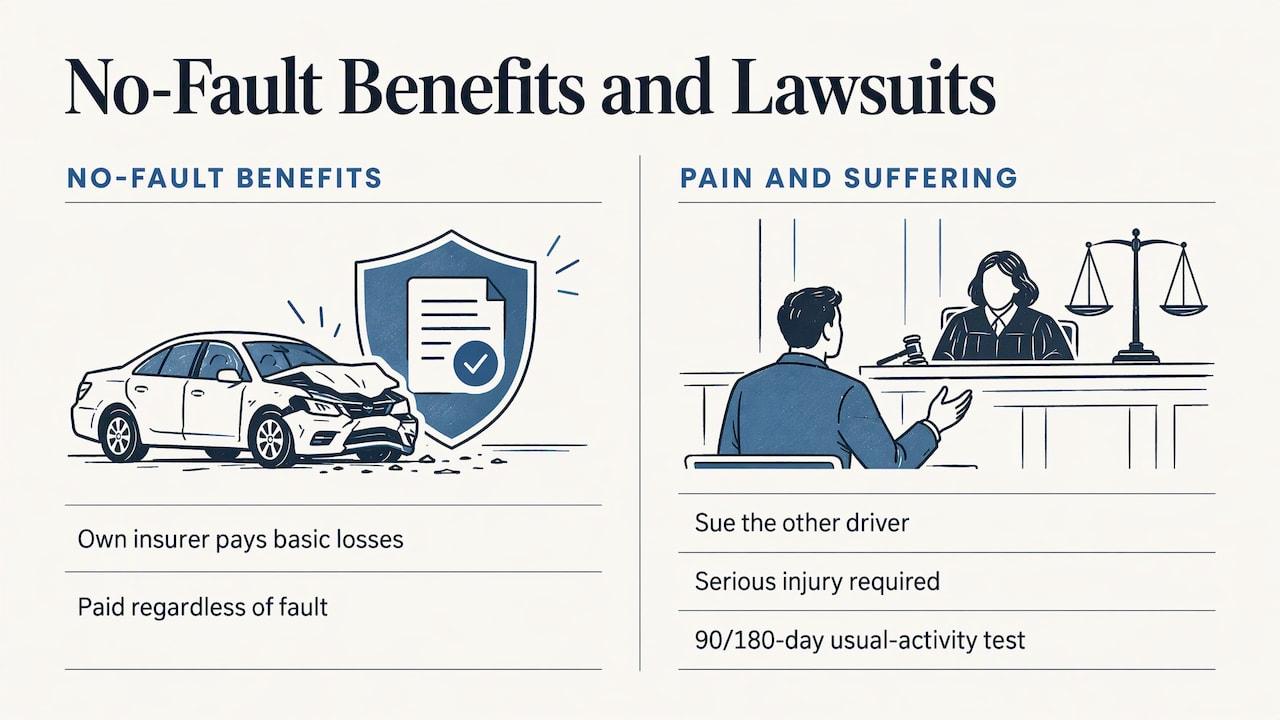
Most brain injury claims in Syracuse start with a motor vehicle crash, and New York’s no-fault system adds a step. Under Insurance Law section 5102, your own insurer pays basic economic losses regardless of fault, but to sue the other driver for pain and suffering you must show a “serious injury” as the statute defines it. The definition includes categories such as a significant limitation of use of a body function or system, and an injury that prevents you from performing substantially all of your usual activities for at least 90 of the 180 days after the crash.
This is where medical documentation becomes decisive. Records that show cognitive testing, specialist evaluations and the real limits on your daily life give the claim the footing it needs. Our car accident page explains how we approach these cases, and our guide on sorting out fault after a car crash covers how liability is decided.
When you were partly at fault
Insurers often try to shift blame onto the injured person: you were not watching, you were walking in the dark, you were not wearing a helmet. New York follows a pure comparative fault rule under CPLR 1411. Your damages are reduced in proportion to your share of responsibility, but you are not barred from recovering. If a jury found you 20 percent responsible for a loss of $500,000, for example, your recovery would be reduced by 20 percent, to $400,000. That example is illustrative only and not a prediction for any case.
Because even small shifts in fault change the final number, how the facts are investigated and presented matters from day one.
How a brain injury case is built
A claim moves through stages. Here is what each involves and where cases go wrong.
- Get medical care and follow the treatment plan. Skipped appointments and untreated symptoms are used to argue the injury is minor. Tell your lawyer about every provider you see.
- Preserve the evidence. Photographs of the scene and your injuries, the police report, witness names, vehicle damage, and any video are all time-sensitive. Surveillance footage at a store or business is often overwritten within days or weeks, so a lawyer should move quickly to request it.
- Limit what you say to insurers. The other side’s adjuster may ask for a recorded statement. Anything you say about symptoms, memory or how the accident happened can be used later. A brain injury can make it hard to recall events accurately, which is another reason to let your attorney handle those conversations.
- Investigate fault and coverage. Thorough investigation identifies every party who may be responsible, such as a driver, an employer, a property owner or a trucking company, and every insurance policy that may apply.
- Document the full impact. Medical records, imaging, neuropsychological testing, statements from family and employers, and records of lost work show what the injury has changed.
- Negotiate, then file suit if needed. Many cases resolve in settlement. When the insurer will not offer a fair amount, the case goes to court.
At our firm, direct communication and thorough investigation are central to how we work, so you know where your case stands at each of these stages.
Workplace, construction and other special cases
If your brain injury happened on the job, workers’ compensation will usually be part of the picture, and a separate claim against a third party, such as a subcontractor, equipment maker or property owner, may also be possible. See our pages on work accidents and construction accidents. For injuries on someone else’s property, see premises liability. Rideshare, truck, motorcycle and pedestrian cases each bring their own insurance and liability questions, and we handle all of them.
How to choose a brain injury lawyer
You are looking for a lawyer who will take the time to understand your injury, not a firm that treats it as one more file. Questions worth asking at a first meeting:
- How long has the attorney handled serious injury cases in this area?
- Who will actually work on my case and answer my calls?
- How are fees charged, and what happens if there is no recovery?
- How will you communicate with me and my family?
- Can you communicate in the language I am most comfortable in?
At our office, Craig K. Nichols has more than 30 years of experience advocating for people injured in auto accidents, truck incidents and wrongful deaths. We pay attention to detail, and we are committed to making sure every client’s voice is heard. We also offer multilingual support and cultural competency for immigrant clients, who sometimes hesitate to pursue a claim because of language barriers or uncertainty about their status. If that is your situation, you can ask us about it directly.
Working with us on a contingency fee basis
Brain injury treatment is expensive, and many families are already losing income when they need legal help. That is why our firm represents injury victims on a contingency fee basis: we only collect a fee if compensation is recovered for you, and consultations are offered on that same basis.
If you or a family member has suffered a brain injury in Syracuse, East Syracuse, North Syracuse or elsewhere in Central New York, contact the Law Offices of Craig K. Nichols to talk through what happened and which deadlines apply to you.
For a wider look at how injury claims work locally, read our guide to personal injury claims in Syracuse.
FAQ
How long do I have to file a brain injury lawsuit in New York?
For most negligence claims, the general limit is three years from the date of injury under CPLR 214. Wrongful death claims generally have two years from the date of death, and claims against a municipality require a notice of claim within 90 days. Because exceptions exist, speak with a lawyer as soon as you can.
What is a brain injury claim worth?
There is no standard amount. Value depends on the severity and permanence of the injury, medical costs now and in the future, lost income, how clear the other party’s fault is, and the available insurance. A lawyer can only estimate a range once the medical picture is clear enough to describe your likely recovery.
Do I need a lawyer if I have a concussion or a mild injury?
A mild diagnosis can still bring lasting symptoms, and insurers often press hard to settle early for a small amount. A lawyer can help you document the effects over time before you sign a release, which generally closes the claim for good.
How much does it cost to hire a brain injury lawyer?
Our firm works on a contingency fee basis, which means we only collect a fee if compensation is recovered for you. We offer consultations on the same basis. We can explain the terms of the agreement before you sign anything.
Can I file a claim if I am not a U.S. citizen?
Yes. Our firm offers multilingual support and consultative help for immigrants navigating personal injury and related claims. Talk with us about your situation so we can explain how your claim would proceed.
Sources
- CDC: About Traumatic Brain Injury
- New York CPLR section 214
- New York EPTL section 5-4.1
- New York General Municipal Law section 50-e
- New York Insurance Law section 5102
- New York CPLR section 1411