
If you were hurt in an Uber or Lyft crash, you probably need a lawyer. These claims involve more than one insurer, and which policy applies depends on what the driver’s app was doing at the moment of impact. At the Law Offices of Craig K. Nichols, ESQ, we have more than 30 years of experience helping injured people in Syracuse and Central New York. We handle rideshare accident cases on a contingency basis, so we only collect a fee if we recover compensation for you.
This guide explains who can be responsible, what coverage can sit behind the claim, what a settlement depends on, and when to make the call.
Key Takeaways
- Coverage in a rideshare crash depends on the driver’s app status: offline, waiting for a request, or on the way to or carrying a passenger.
- Both Uber and Lyft publish higher coverage amounts for the period from accepting a ride through drop-off than for the waiting period.
- No reliable “average settlement” exists. Injury severity, medical costs, fault and the available policy limits decide the number.
- Do not sign a release or accept a quick offer until you know the full extent of your injuries.
- Call a lawyer early if you were hospitalized, a family member died, or more than one insurer is involved.
Table of Contents
- Why rideshare crashes are harder than ordinary car accidents
- How the driver’s app status changes coverage
- Who can be held responsible
- What to do in the hours and days after the crash
- What a rideshare settlement depends on
- Why you should not accept the first offer
- Do I need a lawyer after a car or rideshare accident?
- The rideshare terms you accepted may matter
- How we handle rideshare cases
- Frequently Asked Questions
- Sources
Why rideshare crashes are harder than ordinary car accidents
In an ordinary two-car collision, you deal with the other driver’s insurer. In a rideshare crash, up to four parties can be in the picture: the rideshare driver, the driver’s personal insurer, the rideshare company’s insurer, and sometimes a third driver who caused the collision.
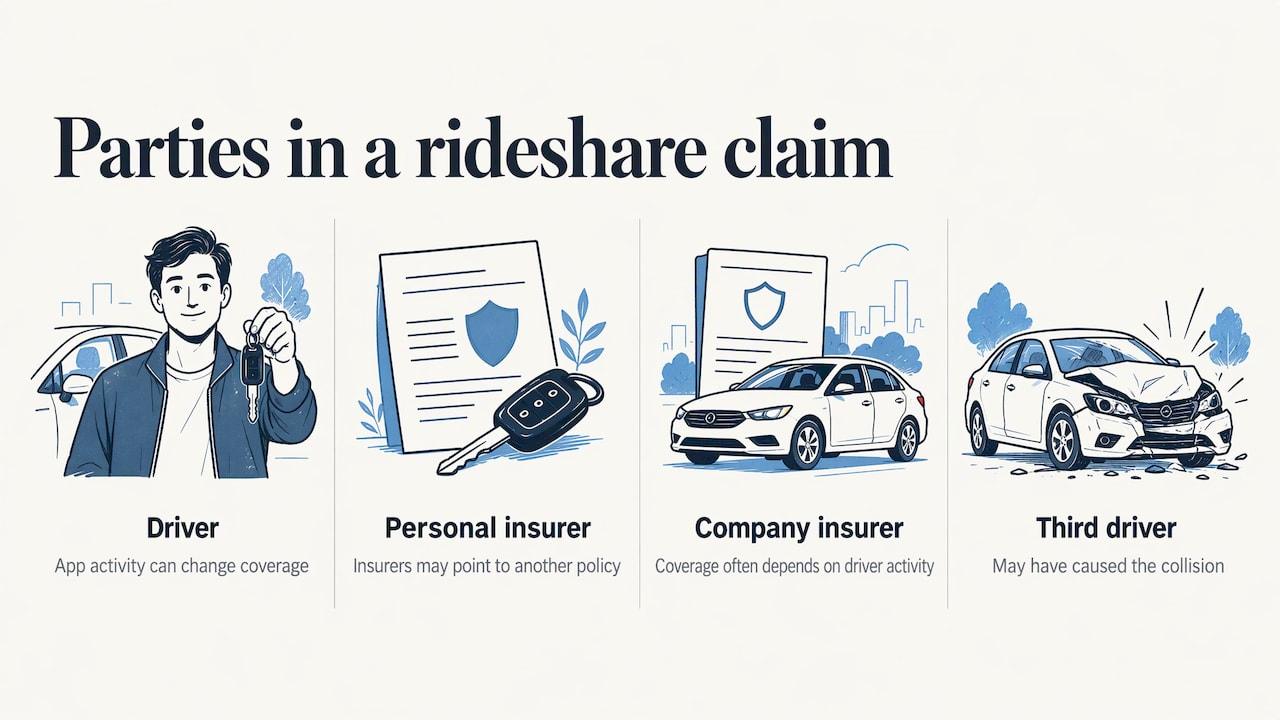
The company’s coverage often depends on what the driver was doing. A driver with the app off is in a different position from one who has just accepted a ride request. Insurers know this, and each has a reason to point at another policy. Sorting out who owes what is a large part of the work.
Your own position matters too. You might have been a passenger, the driver of another car, a pedestrian, a cyclist or a motorcyclist. The Texas Department of Insurance lists the kinds of losses a rideshare crash can cause. They include injury to pedestrians or occupants of another vehicle, damage to vehicles and other property, and damage to the personal property of passengers and drivers. You do not have to be in the rideshare car to have a claim.
How the driver’s app status changes coverage
Uber and Lyft describe their coverage in phases. These phases are the starting point for almost every rideshare claim.
| App status | What the companies say they provide |
|---|---|
| App off | Lyft states that no Lyft policy applies and the driver should contact their personal insurer |
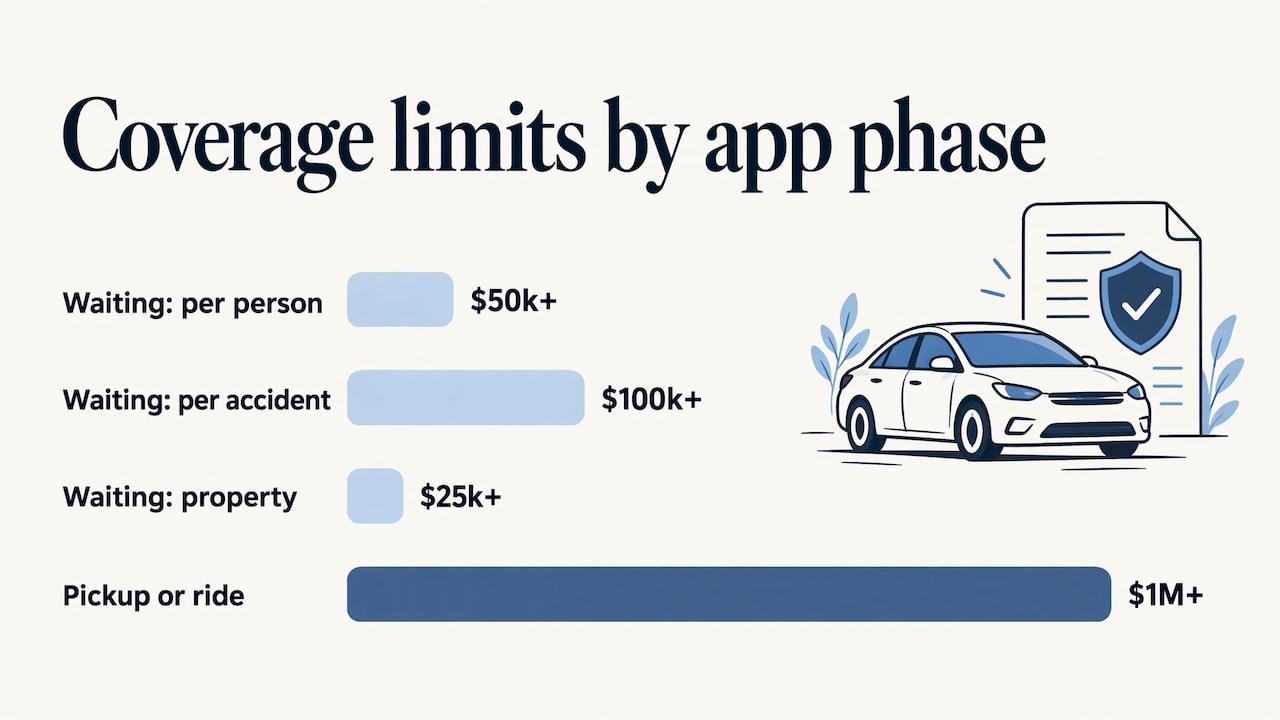
| Online, waiting for a request | Uber lists third-party liability of at least $50,000 per person and $100,000 per accident for injuries, plus $25,000 per accident for property damage |
| En route to a pickup or on a trip | Uber states at least $1 million in liability coverage for injuries and property damage involving riders and third parties when the driver is at fault. Lyft lists at least $1 million in most markets for pickup or ride periods |
The waiting-period figures are the same $50,000/$100,000/$25,000 split on both platforms. Lyft’s page adds that this coverage applies if the driver’s personal insurance does not, with exceptions. These are the companies’ own published terms and they can change, so the current text on each page controls.
The gap between $100,000 per accident and $1 million is large. If a serious injury happens while the app is on but no ride has been accepted, the available coverage may be much lower than the same crash a minute later. Proving what the app was doing at the time can change the value of a claim.
State rules also set minimums. Nevada’s insurance regulator, for example, publishes its own required limits for each phase, and they differ from state to state. Which state’s rules apply depends on where the crash happened. For a crash in Syracuse or elsewhere in New York, we review the New York requirements and the policies involved for your specific case.
Who can be held responsible
Several parties may share responsibility, depending on how the crash happened:
- The rideshare driver, if the driver was careless, distracted, speeding or impaired.
- The other driver, if someone outside the rideshare car caused the collision. Your claim then runs mainly against that driver’s insurance, and the rideshare coverage may play a smaller role.
- The rideshare company, through the insurance it maintains for drivers on the app. How far the company’s own liability extends is a legal question that depends on the facts.
- A road or property owner, in less common cases involving dangerous conditions.
Fault is rarely a simple yes or no. Our article on sorting out liability in a car accident explains how responsibility is divided when more than one person contributed.
What to do in the hours and days after the crash
What you do early shapes the evidence. The New Hampshire Insurance Department’s 2022 consumer guide gives sound basics that apply anywhere: report the loss promptly to your insurer and the police, obtain the police report, and cooperate with the investigation. Here is how that translates to a rideshare crash.
- Get medical care first. Some injuries, including head, neck and back injuries, can show up hours or days later. A medical record made soon after the crash also ties your injuries to it.
- Call 911 and get a police report. Ask the officer how to get the report number.
- Record the driver and app details. Take a screenshot of the trip in your app if you were a passenger. Note the driver’s name, license plate and vehicle. Photograph the scene, the cars and your injuries.
- Get witness names and phone numbers.
- Keep your trip receipt and app messages. They show the time and the app status.
- Report the crash to your own insurer. Policies set duties after a loss, and your own coverage, such as uninsured or underinsured motorist coverage, may matter.
- Do not sign a release. The same New Hampshire guide warns against signing a bodily-injury release unless you are prepared for it to end further claims against the other driver and insurer. That applies to any quick settlement paper from a rideshare company’s insurer too.
- Do not give a recorded statement before you have spoken to a lawyer. Adjusters ask for them early, and your words can be used to reduce your claim.
An injured passenger faces particular questions. Our page on what to do as an injured passenger covers them.
The District of Columbia insurance regulator suggests that rideshare drivers review personal and company policies for coverage start and end times, medical payments and uninsured motorist coverage, among other items. Those are the same questions we work through when we trace the coverage behind a claim. If you were driving for a rideshare company yourself and got hurt, we do that work for you.
What a rideshare settlement depends on
People search for the “average car accident settlement” because they want to know what their case is worth. The honest answer is that no average tells you that. One crash can end with a few thousand dollars in medical bills. Another can change a life.
The Insurance Research Council’s 2018 study of more than 85,000 closed claims from nine insurers, covering about half the U.S. private passenger market, gives some context. It found that claimed economic losses for bodily injury claims averaged $20,397 in 2017, while total bodily injury payments averaged $15,037. Those figures are for all auto injury claims from that period, not rideshare claims, and the averages blend minor claims with serious ones. Do not use them as a prediction for your own case.
The same study points to what really drives recoveries. One in 10 bodily injury claimants had claimed economic losses above their per-person policy limit. In other words, policy limits can cap what is available even when losses are higher. That is why finding every policy that could apply, including the higher coverage tied to an active ride, matters in a rideshare case.
The main factors in a settlement are these:
- Medical expenses, past and future, including surgery, therapy and long-term care.
- Lost income and any lasting loss of earning ability.
- Pain and suffering, which reflects how the injury changes your daily life.
- Fault, including any share of responsibility an insurer tries to place on you.
- Available coverage, which is driven by the app status and the policy limits discussed above.
- Documentation, such as medical records, photos, the police report and witness accounts.
We do not promise any outcome in advance, and no honest lawyer can. What we can do is build the evidence and identify the coverage so that an offer is measured against your real losses, not against an insurer’s opening number.
Why you should not accept the first offer
The first offer usually arrives quickly. It often comes before you know whether your injury needs surgery, months of therapy or time away from work. Once you sign a release, the claim is over, even if your condition gets worse.
Injuries from crashes can develop slowly. Chronic pain, spinal injuries and head injuries can take time to diagnose. Waiting until your treatment picture is clear gives your claim a more accurate value. A lawyer can handle the insurer’s calls while you focus on recovery.
Do I need a lawyer after a car or rideshare accident?
Not every fender bender needs one. Consider calling a lawyer when any of these apply:
- You were taken to the hospital or are still in treatment.
- A family member was killed. Our wrongful death practice helps families through that claim.
- More than one insurer is involved, or the rideshare company or its insurer contacts you.
- Fault is disputed or the other side blames you.
- You were an employee or driver working at the time.
- You are offered a settlement or asked to sign something.
- You are an immigrant or non-citizen and worry that making a claim could affect your situation. We offer multilingual support and consultative help for immigrant clients.
The earlier you call, the more evidence there is to protect. Photos can be lost, app data can change, and witnesses forget. Deadlines to bring a claim are strict in New York, and some insurance steps, such as no-fault applications, carry short deadlines of their own. A lawyer can confirm the exact time limits for your situation so you do not lose a claim by waiting.
The rideshare terms you accepted may matter
Riders agree to the app’s terms when they sign up. Some terms can require disputes to go to arbitration instead of court. A 2023 New Jersey appellate decision, Williams v. Ysabel, upheld an order sending claims against Uber to arbitration based on the specific agreement and how the user assented to it. The court’s ruling turned on the particular terms in that record. It is not a universal rule for every rider, and the answer can differ by state, agreement and claim.
This is a good reason to have a lawyer read the actual terms. Claims against the driver, another motorist or an insurer may follow a different path from a claim against the company itself.
How we handle rideshare cases
Our approach is built around personal attention. Craig K. Nichols has more than 30 years of experience representing people hurt in car, truck and other serious accidents, and the firm has secured millions of dollars for clients. We investigate thoroughly and talk with you directly, so you know where your case stands.
We handle matters on a contingency fee basis, which means we only collect a fee if compensation is recovered for you. The consultation is offered on the same basis. If you are hurt in a crash with an Uber, a Lyft or another vehicle, our rideshare accident page describes how we help. If another driver caused your crash, our car accident team can review it as well.
We serve Syracuse, East Syracuse, North Syracuse and the rest of Central New York, and we help clients in the language they are most comfortable in. To start, contact the Law Offices of Craig K. Nichols and tell us what happened.
Frequently Asked Questions
Can I sue Uber or Lyft after a crash?
Sometimes. Whether the company is responsible, or its insurance pays, depends on who was at fault and what the driver’s app was doing. The company’s published coverage applies in specific phases, and the terms you agreed to in the app may affect where the claim is heard. A lawyer can review the facts and the documents and tell you which route fits your case.
Who pays if the Uber or Lyft driver had the app off?
Lyft states that no Lyft policy applies when its app is off. In that case the driver’s personal auto insurance is the main source of coverage. Your own policy may also help, for example through uninsured or underinsured motorist coverage. Proving the app status at the time of the crash is important.
What is the average car accident settlement?
There is no dependable figure for your case. Settlements range widely based on injuries, medical bills, lost income, fault and policy limits. The Insurance Research Council’s 2018 study reported an average bodily injury payment of $15,037 for 2017, but that blends all claims, including minor ones, and says little about a serious injury.
When should I hire a lawyer after a car accident?
As soon as you have a serious injury, a death in the family, a disputed fault question, or a request to sign a release or give a recorded statement. Calling early protects evidence and keeps you from making mistakes with the insurer. With a contingency arrangement, you do not pay a fee unless there is a recovery.
Sources
- Insurance coverage while driving with Lyft, Lyft Help
- Insurance for Rideshare Drivers, Uber
- Ride sharing: 3 questions to ask, Texas Department of Insurance
- Transportation Network Companies and Auto Insurance FAQ, Nevada Division of Insurance
- Insurance gaps for private auto for hire, District of Columbia Department of Insurance, Securities and Banking
- 2022 Automobile Insurance Consumer FAQ, New Hampshire Insurance Department
- Countrywide Patterns in Auto Injury Insurance Claims, Insurance Research Council, 2018
- Williams v. Ysabel, A-1391-22, New Jersey Appellate Division, 2023