If you were injured because a store, landlord, restaurant or other property owner let a dangerous condition go unfixed, you may have a premises liability claim, and a lawyer who handles these cases can tell you quickly whether yours holds up. At the Law Offices of Craig K. Nichols, ESQ, we have represented injured people in Syracuse and Central New York for over 30 years, and premises liability is one of the areas we handle. We work on a contingency fee basis: we only collect a fee if we recover compensation for you.
This guide explains the idea in plain terms: when an owner is responsible, what you have to prove, what evidence disappears fastest, and what a lawyer actually does for you.
Key Takeaways
- Premises liability means a property owner or the person in control of a property can be responsible when an unsafe condition they knew about, or should have found, injures a lawful visitor.
- An accident alone does not make an owner liable. You must show a duty of care, a breach of it, that the breach caused your injury, and real damages.
- The first days matter most: photos, witnesses, incident reports and medical records are easiest to collect early, and filing deadlines are strict, especially against government bodies.
- We handle premises cases on contingency, so you owe no attorney’s fee unless we recover compensation for you.
Table of Contents
- What premises liability means
- Who can be responsible for your injury
- What you have to prove
- A worked example
- Evidence to protect right away
- Deadlines and claims against government
- What a premises liability lawyer does
- How we can help in Syracuse
- How premises lawyers are paid
- When to call a lawyer
- FAQ
- Sources
What premises liability means
Premises liability is the area of personal injury law that deals with injuries caused by the condition of a property. The classic example is a slip and fall, but the category is wider: broken stairs, poor lighting, a loose handrail, an icy entrance, a cracked parking lot, a neglected apartment hallway or an unsecured swimming pool all fit.
The core rule is consistent across the country. A Texas real estate research report summarizes it this way: a party who possesses or controls property may be liable for an unreasonably dangerous condition if it knew, or should have known, about the risk and failed to take reasonable steps to reduce or remove it or to warn people. Each state writes its own details, so the exact rules that apply to your case come from New York law. The logic, though, is the same one you will hear from any court.
Two phrases come up constantly:
- Actual knowledge: the owner or staff knew about the hazard, for example because a customer reported the spill or an employee created it.
- Constructive knowledge: the owner did not know, but the hazard existed long enough, or was the kind of problem a reasonable inspection would have caught.
Constructive knowledge is where many real cases are decided. The New Jersey Courts’ premises liability guide explains that a business owes its customers protection from dangerous conditions that are known or reasonably discoverable, including through reasonable inspections. In other words, “I never saw it” is not always a defense. If a routine walk-through would have found it, the owner may still answer for it.
Who can be responsible for your injury
People often assume the building owner is the only target. Responsibility actually follows control. The Texas Real Estate Research Center’s guide lists several possibilities: an owner, a property manager, a tenant or lessee who controls the space, and in some circumstances a contractor who took over control and responsibility for an area.
Here is how that plays out in Central New York:
| Where you were hurt | Who may be responsible |
|---|---|
| Grocery store, retail shop, restaurant | The business operating the store, and sometimes the landlord who owns the building |
| Apartment building hallway, stairwell or parking area | The landlord or the management company that maintains common areas |
| Icy walkway outside an office or shop | The party responsible for maintaining that walkway, which may be the owner, the tenant or a contractor hired for snow removal |
| Construction or renovation area open to visitors | The property owner, the general contractor, or both, depending on who controlled the area |
| Public sidewalk, park or government building | A government body, which brings special rules and shorter notice deadlines |
Identifying the right defendant is not a formality. Name the wrong party, or miss one, and you can lose the claim or the insurance coverage that would have paid it. Sorting out who controlled the area on the day you were hurt is one of the first things we investigate.
What you have to prove
An injury on someone’s property does not automatically make the owner liable. The New Jersey Courts’ guide makes this point directly: liability depends on a duty of care, a breach of that duty, and an injury caused by the breach. A model jury instruction from the Massachusetts District Court, revised in May 2024, lists the same four elements for a negligently maintained property claim, including a fall: duty, breach, causation and damages, each proven by a preponderance of the evidence. That phrase means “more likely than not,” a lower bar than the “beyond a reasonable doubt” standard you may know from criminal cases.
In plain terms:
- Duty. The owner or occupier owed you reasonable care. The Massachusetts instruction says a property owner or other person in control owes that care to people lawfully on the premises, including guests and customers.
- Breach. The owner failed to act reasonably: they ignored a hazard, skipped inspections, failed to repair or failed to warn.
- Causation. That failure, and not something else, caused your injury.
- Damages. You suffered real losses, such as medical bills, lost income and pain.
The Wisconsin State Bar’s personal injury guide puts the commercial version simply: you generally need an unsafe condition that the owner should have known about, appreciated and corrected before the accident.
What “reasonable” means in practice
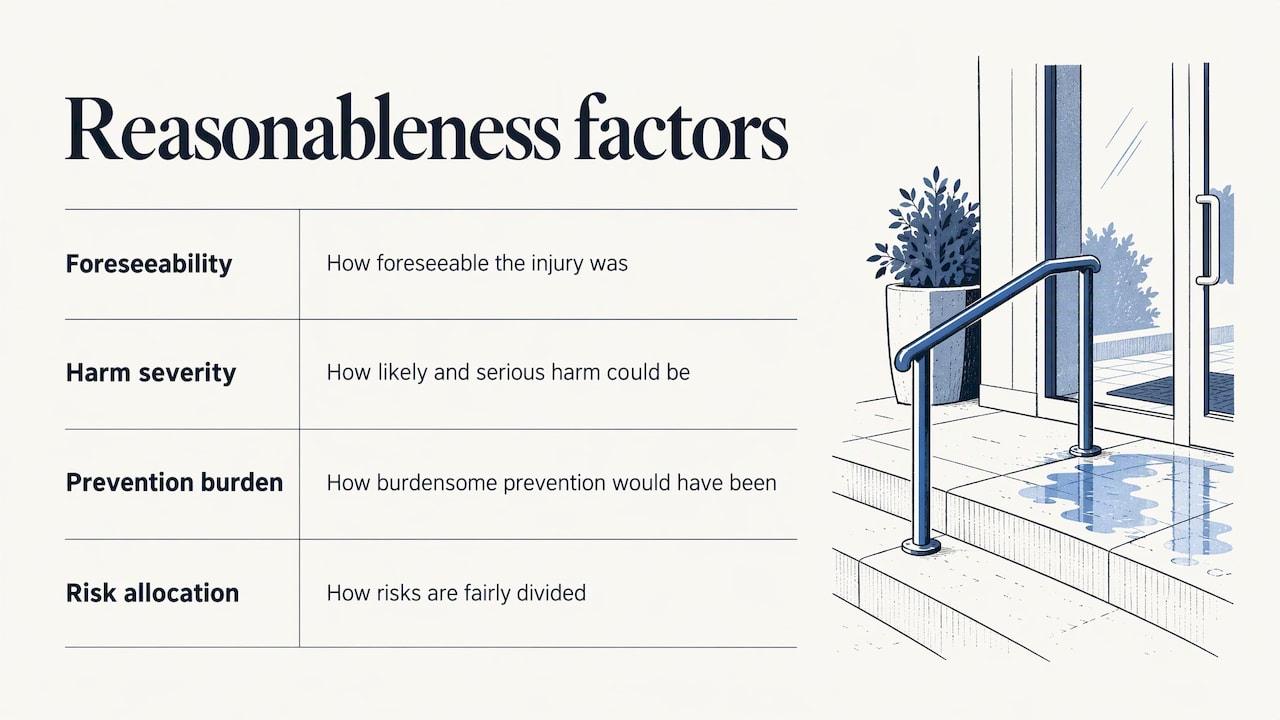
There is no checklist that fits every property. The Massachusetts model instruction describes premises safety as a question of reasonableness in context. It points to how foreseeable the injury was and how likely, how serious the harm could be, how burdensome prevention would have been, and how risks are fairly divided. A wet entrance in a snowstorm and a spill in a dry grocery aisle are judged against different expectations. A broken handrail that costs a few dollars to fix and protects every visitor on a staircase is hard to defend.
Obvious dangers
Owners often argue that the hazard was obvious. The Massachusetts instruction says an owner generally does not have to warn about an open and obvious danger. It adds that the owner may still have to fix the problem if harm to a lawful visitor should be expected even though the danger is plain. So an obvious hazard does not automatically end a claim, but it makes the facts around it more important: lighting, distractions, whether you had another route, and whether the owner could have anticipated that people would use the area anyway.
A worked example
Say you walk into a Syracuse supermarket on a snowy afternoon. Customers have tracked slush across the entrance, and the floor near the door is wet. There is no mat and no warning sign. You slip and fracture your wrist.
A premises claim would ask:
- Duty: you were a customer, lawfully there, so the store owed you reasonable care.
- Breach: did staff know about the wet floor, or should an ordinary inspection routine have caught it? How long had the slush been there? Were mats or signs put out on a day like this?
- Causation: do the video and your account show the wet floor was what made you fall?
- Damages: the fracture, the treatment, time off work and any lasting loss of use.
Notice that the answers rarely come from you alone. They come from the store’s cleaning logs, camera footage, inspection records and staff statements, and these are in the owner’s hands. That is a large part of why people with serious injuries bring in a lawyer early.
Evidence to protect right away
After a fall or other injury on someone’s property, get medical care first. Your health comes before the claim, and prompt treatment also creates a record connecting the injury to the incident. Then, as far as you are able:
- Photograph the hazard and the area before it is cleaned or repaired: the spill, the broken step, the ice, the missing sign, the lighting.
- Report the incident to the manager, landlord or property staff, and ask for a copy of any incident report or at least the name of who took it.
- Get names and numbers of witnesses and employees who saw what happened.
- Keep your shoes and clothing from the day, unwashed.
- Save every medical record, bill and work-absence note.
- Write down what happened while it is fresh, including the time, the weather and what you were doing.
- Be careful with statements. Do not give a recorded statement to the property’s insurer before you understand your rights.
Video is the item most often lost. Businesses routinely overwrite camera footage on a short cycle, so a request that goes out in the first days can decide whether the footage exists at all. Preservation requests and follow-up are part of what we do when we take a case.
Deadlines and claims against government
Every state sets a time limit for filing an injury lawsuit, and the clock can be shorter than people expect. Deadlines also depend on who is responsible. As an example of how the pattern works, the Wisconsin State Bar’s guide lists a three-year general limit for personal injury in that state, but a 120-day notice period for claims against city, county or school employees. It also cautions that claims involving government bodies and premises carry stringent notice and claim requirements. The New Jersey Courts’ guide shows that public property can follow a different standard altogether: the claimant must show a dangerous condition, a foreseeable risk of injury, and that the public entity created the condition or knew of it and acted in a palpably unreasonable way by not addressing it.
Those are other states’ rules, offered to show the shape of the problem. New York has its own limits and notice rules, and which one applies to you depends on who owned or controlled the property. The practical lesson is the same everywhere: if a city sidewalk, a public building or a school was involved, speak with an attorney quickly rather than waiting to see how your recovery goes.
What a premises liability lawyer does
A premises case is rarely a matter of filling in a form. Fault is usually disputed, the evidence sits with the other side, and insurers have their own investigators. The California Courts’ Self-Help Guide notes that legal help is especially important when injuries are severe or long-term, when damages may be large, or when fault is unclear. Those describe most premises claims that reach a lawyer’s office.
Our work on a premises case typically runs through these stages:
- Listening first. We start with your account and your injuries, and we speak with you directly throughout the case.
- Investigation. Thorough investigation is how we work: identifying who owned and controlled the property, gathering photos, records and witness information, and looking at what the owner knew or should have known.
- Building the damages picture. Medical treatment, lost income and the long-term effect of the injury, including serious ones such as head and brain injuries or spinal cord injuries, which we also handle.
- Negotiating with insurers. Most claims are resolved by negotiation, and the outcome depends on how well the liability and damages are documented.
- Filing suit when needed. If a fair resolution is not offered, the claim can go to court.
The litigation side is its own discipline. The American Association for Justice publishes practitioner materials on slip, trip and fall cases covering discovery, motions in limine (requests to limit what evidence a jury may hear), trial transcripts and continuing legal education. That gives a sense of how much procedure sits behind a claim that looks simple from the outside.
How we can help in Syracuse
The Law Offices of Craig K. Nichols, ESQ represent people injured in Syracuse, East Syracuse, North Syracuse and across Central New York. Our premises liability practice covers falls and other injuries caused by unsafe property, and our page on slip and fall cases walks through the most common fact patterns. We also handle dog bites, work and construction accidents, and wrongful death claims for families.
We offer multilingual support and cultural competency for immigrant clients, and we consult with immigrants and non-citizens about personal injury and related claims. Every case gets Craig Nichols’ personal attention, because for us every case is personal.
If you were hurt on someone’s property, you can contact our office through the main site to talk through what happened. The consultation is on a contingency fee basis.
How premises lawyers are paid
Most injured people worry about the cost before anything else. Personal injury lawyers commonly work on contingent fees: the fee is a share of what is recovered, and it varies with the type of case, its difficulty and its expense, according to the Wisconsin State Bar. The same source notes that, in Wisconsin, such agreements must be in writing and address out-of-pocket expenses. Those expenses may be advanced by the lawyer and repaid from the recovery in addition to the fee.
The point worth taking from this is to understand your fee agreement before you sign: what percentage applies, how case costs are handled, and when they are repaid. With us, the structure is simple at its core: we collect a fee only if we recover compensation for you. Ask us any question about the agreement and we will go through it with you.
When to call a lawyer
You do not need a lawyer for every minor stumble. You should call one when:
- your injury is serious, needed surgery or ongoing treatment, or has kept you from working;
- the owner or insurer is blaming you or saying the hazard was obvious;
- you are not sure who owned or controlled the property;
- a government property, a rental building or a contractor’s work area was involved;
- a family member died after a fall or a property-related accident, in which case a wrongful death claim may be involved;
- an insurer has asked for a recorded statement or offered a quick settlement.
These are the situations the California Courts’ guide describes when it says legal help matters most: severe or long-term injuries, large potential damages and unclear fault.
FAQ
Is a premises liability lawyer the same as a personal injury lawyer?
Premises liability is one type of personal injury case, so a personal injury lawyer who handles property-related injuries can represent you. What matters is experience with these claims. Our office has handled personal injury cases in Syracuse for over 30 years, premises cases among them.
Do I have a case if I fell on someone’s property?
Not automatically. You generally must show the owner or occupier owed you reasonable care, failed to provide it, and that the failure caused your injury and losses. A hazard the owner knew about, or should have found through reasonable inspection, is the strongest starting point.
What if the danger was obvious?
An obvious hazard does not always end a claim. According to the Massachusetts District Court’s May 2024 instruction, an owner may still have to remedy a danger when harm to a lawful visitor should be anticipated despite it being obvious. The details of your case decide how that plays out.
What does it cost to hire a premises liability attorney?
We work on a contingency fee basis, which means we collect a fee only if we recover compensation for you. Ask us to explain how case expenses are handled in the written agreement before you sign.
How long do I have to file?
Deadlines vary by state and by who is responsible, and claims against government bodies can carry much shorter notice periods. Because the right deadline depends on the facts, contact an attorney as soon as you can after the injury.
Sources
- Land Occupier’s Liability Guide, Texas Real Estate Research Center
- Premises Liability Law, New Jersey Courts
- 4.00 Overview of Elements and Duty, Massachusetts District Court
- Personal injury guide, Wisconsin State Bar
- Personal injury cases, California Courts Self-Help Guide
- Slip Trip Fall litigation materials, American Association for Justice